External Entity Linking (External EL or EEL) is a Schema App feature that automatically identifies entities in your content and connects them to authoritative external knowledge sources using Schema Markup. By linking content to recognized entities from sources such as Wikipedia, Wikidata, and the Google Knowledge Graph, External Entity Linking provides additional semantic context that helps search engines better understand the meaning of your content.
After reading this article, you will understand how External Entity Linking works, how it is implemented in Schema App, what types of entities it can identify, and the content considerations and limitations that impact its effectiveness.
TABLE OF CONTENTS
- Context, Required Knowledge, & Why This Article?
- What is External Entity Linking?
- How is External Entity Linking Implemented?
- How Can I Confirm External Entity Linking Is Working?
- Best Practies for Better Entity Identification
- External Entity Linking Limitations
- Conclusion
Context, Required Knowledge, & Why This Article?
Schema App's Entity Linking service helps search engines better understand the entities referenced in your content. External Entity Linking is used to automatically identify entities and associate them with authoritative external identifiers. External Entity Linking will add to the JSON-LD deploying to your webpages. Understanding this process and how it can improve semantic understanding of your content will help you make informed decisions when implementing Entity Linking as part of your semantic SEO strategy.
External Entity Linking is one method used within Schema App's Entity Linking service. Results depend on both the quality of the content being analyzed and the availability of authoritative identifiers for the entities referenced.
What is External Entity Linking?
External Entity Linking (External EL) is the automated process of identifying named entities in text and linking them to authoritative external knowledge bases. When External EL identifies an entity within your content, it associates that entity with external identifiers from sources such as Wikipedia, Wikidata, and the Google Knowledge Graph. These identifiers are then incorporated into your Schema Markup to provide additional semantic context.
External EL is designed to help search engines understand exactly which people, places, organizations, products, and concepts are being referenced within your content.
Why is External Entity Linking Important?
Entities embedded within your Schema Markup provide additional semantic signals that help search engines interpret your content more accurately. By linking content to recognized entities, External EL reduces ambiguity and helps search engines connect your content to established concepts within external knowledge graphs. This can improve how content is understood and matched to relevant user searches.
How Does External Entity Linking Work?
External EL tags can be applied to Schema App Highlighter templates. Once configured, the selected content is processed through an API that identifies entities and retrieves associated external identifiers. When a recognized entity is found, the API may return:
- The entity type (for example, Organization or Person)
- The entity name
- One or more external identifiers from authoritative sources
The results from External Entity Linking will be cached for 12 weeks.
What External Authoritative Sources Are Used?
External EL may return identifiers from one or more of the following sources:
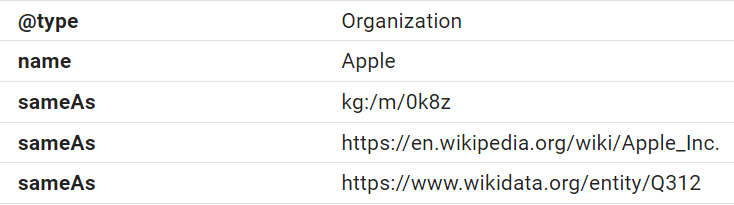
- Wikipedia URI (e.g. https://en.wikipedia.org/wiki/Apple_Inc)
- Wikidata URI (e.g. https://www.wikidata.org/entity/Q312)
- Google Knowledge Graph URI (e.g. kg:/m/0k8z)
- Crunchbase URI (e.g. https://www.crunchbase.com/organization/communitech)
- LinkedIn (e.g. https://www.linkedin.com/in/danielwaisberg/)
These external identifiers are added to the entity using the sameAs property in the resulting Schema Markup. The markup will look something like this:
How is External Entity Linking Implemented?
External EL implementations are typically planned in collaboration with your Customer Success Manager (CSM).
The first step is identifying a page set that contains meaningful entities such as people, organizations, places, products, or concepts. Once the content has been identified, the next step is determining which schema.org property should receive the returned entities.
Choosing the Right Schema Property
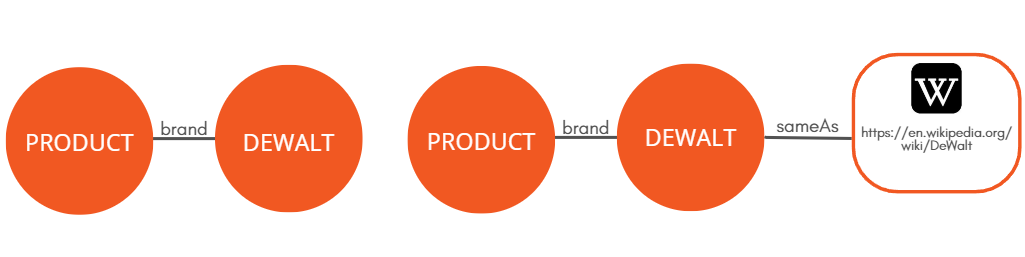
The property selected for External EL depends on the types of entities you expect to identify. If your content contains a variety of entity types, it is generally recommended to use a property that accepts schema.org/Thing. This allows entities of different types to be added without restriction.
Common Examples
- Use
mentionson a BlogPosting to capture entities of any type. - Use
areaServedwhen only Place entities should be returned. - Use
brandwhen only Organization entities should be returned.
Restricting External EL to a specific entity type allows you to use more precise schema.org properties when appropriate.
What Types of Entities Can External EL Identify?
External EL can identify entities using the following schema.org types:
- Date
- ContactPoint
- CreativeWork
- Event (deployed as Thing)
- Number
- Offer
- Organization
- Person
- Place
- PostalAddress
- Product (deployed as Thing)
- Thing
Why Are Product and Event Entities Typed as Thing?
The underlying API is capable of identifying Product and Event entities. However, these schema types may be eligible for Google Rich Results. If incomplete Product or Event markup is detected, Google Search Console can generate enhancement report errors. To avoid creating unnecessary reporting issues, Schema App converts the Product and Event entities to Thing rather than their more specific schema types.
How Can I Confirm External Entity Linking Is Working?
After pages have been processed through the External EL API, identified entities begin appearing within Entity Reports in the Entity Hub. For more information about Entity Reports, view our support documentation here.
When Do Results Appear?
The External Entity Linking tag will run when a page is visited. The initial page visit triggers the processing workflow. Once processing has completed, identified entities will appear within the markup and become available through Entity Reports on subsequent page visits. For additional information, refer to the Entity Reports documentation.
Best Practies for Better Entity Identification
The quality of your content has a significant impact on the accuracy of External EL results. Following entity-focused content best practices can improve recognition and matching.
Use Standardized Entity Names
Whenever possible, use names and terminology that can be found in authoritative knowledge sources such as Wikipedia and Wikidata. Using recognized names improves the likelihood that entities will be identified correctly while still allowing content to be optimized for human readers.
Why Is Capitalization Important?
Capitalization helps distinguish proper nouns from common nouns with similar names.
For example, "Apple" may refer to the technology company, while "apple" refers to the fruit. Consistent capitalization helps External EL determine the correct entity.
How Does Context Affect Entity Matching?
External EL evaluates surrounding content to determine which entity is most likely being referenced. For example, the term "Amazon" may be interpreted differently depending on nearby content:
- Words such as "technology", "e-commerce", and "digital streaming" suggest Amazon the company.
- Words such as "rainforest", "biodiversity", and "tropical" suggest the Amazon rainforest.
This approach is similar to keyword clustering in traditional content SEO but also considers how natural language processing systems interpret content.
External Entity Linking Limitations
While External EL can significantly improve semantic understanding, there are limitations related to both the underlying API and account-level processing limits.
Limitations of API Results
External EL requires authoritative identifying information to successfully return entities. If an entity does not have supporting metadata such as a Wikipedia URL or Google Knowledge Graph identifier, the API may not return a result. The API used for External EL has an estimated accuracy rate of approximately 83%. As a result, occasional incorrect matches can occur. For example, a reference to Hamilton could be incorrectly linked to the person rather than the city. Users can leverage Entity Manager to edit entity properties, improve accuracy, or block irrelevant entities from being deployed.
For additional information, refer to the Entity Manager documentation.
Tag Run Limitations
External EL tags can process up to 10,000 executions across up to 10,000 characters per URL. For example:
- One External EL tag can run across 10,000 URLs.
- Two External EL tags can run across 5,000 URLs.
Organizations that require additional processing capacity can purchase expanded limits as a monthly add-on.
Conclusion
External Entity Linking automatically identifies entities within your content and connects them to authoritative external knowledge sources through Schema Markup. By adding semantic context and reducing ambiguity, External EL helps search engines better understand the people, places, organizations, products, and concepts discussed throughout your content.
Successful implementations combine high-quality content, appropriate schema.org properties, and ongoing review of identified entities to maximize semantic SEO value.
If you have questions about External Entity Linking on your account, contact your Customer Success Manager or reach out to support@schemaapp.com.
Was this article helpful?
That’s Great!
Thank you for your feedback
Sorry! We couldn't be helpful
Thank you for your feedback
Feedback sent
We appreciate your effort and will try to fix the article